
This utility updates the system firmware and provides the following benefits: Enables remote movie shooting using a smartphone Note: For movie shooting, using the smart remote control function, ensure the 'PlayMemories Mobile' app is updated to the latest version (Ver. Each year, Apple makes improvements to macOS, the operating system (OS) you use on your Mac. The annual Apple Mac update cycle often brings iterative tweaks, but some years have major changes. Your macOS operating system – or OS X, for older versions of macOS – can be updated each Fall, so long as Apple is still supporting your device.
Dec 21, 2020 • Filed to: Solve Mac Problems • Proven solutions
Part One: Introduction
Part Two: Why Can't I Update My Mac?
Part Three: How Do I Update My Operating System on My Mac?
Part Four: What Do I Do If My Mac Won't Update?
Part Five: Recover Your Data
Have you ever found yourself staring at a computer screen, clutching your head in your hands, and asking the question, 'Why won't my Mac update?'
Computer trouble is always frustrating, and even more so with Macs because, to be frank, things don't go wrong very often on a Mac. It gets easy to expect that nothing ever will.
But if you find yourself staring down a computer that just will not work right, don't worry. There are ways to fix a corrupted Mac OS update. Read on to learn the symptoms of a corrupted update and what you can do about it.
Why Won't My Mac Update?
You might see these problems or errors when you're trying to update your Mac. Here's what's causing them.
Symptoms and Error Messages
Update System Ruby Mac
If you have a problem with your Mac's latest update, chances are the problems are going to show up when you try to boot up the computer. You may get a message that reads 'A critical software update is required for your Mac, but an error was encountered while installing this update. Your Mac can't be used until this update is installed.'
You could also start getting a screen with a black background and white text in four languages. The text will read, 'You need to restart your computer. Hold down the Power button for several seconds, or press the Restart button.'
In some cases, your Mac won't even get as far as booting up long enough to get you an error message. Some update problems can be so severe that your system won't boot up at all, even if you know the computer is plugged in and working fine.
More commonly, you may see a system that begins to boot and then crashes. Your Mac may get stuck on a blue or gray screen and refuse to move from there. Or you may get a flashing question mark on your screen.
Causes of the Problem
Oftentimes if your Mac runs into an issue with an update, it's because the update process was interrupted somehow. Maybe you lost power or lost patience and unplugged the computer partway through the process. If a laptop battery died or you tried to turn a system off before it finished updating, it can land the computer in a sort of limbo between updated and running an update.
Imagine if you and a friend were driving down a highway you know when you fell asleep. Once you woke up, you were on a stretch of road you didn't recognize, and you didn't know how to get back home or to your destination.
That's the state your computer finds itself in when an update is interrupted – as long as it's got power during the update, it knows where it is on the road, but as soon as it goes to sleep, it's lost the way.
If your computer won't boot up or boots and then crashes, you may be dealing with a problem called a kernel panic. This is where your computer runs into a critical problem when it tries to turn on. Its response to hitting critical problems is to try to start fresh, so it reboots, but if the problem is with the system, it can get stuck in an endless loop of reboots and crashes.
There are a ton of things that can cause a kernel panic, including installing new apps or not getting them installed in the right folder. You may have outdated drivers or plugins or apps that conflict with each other. There may also be some hardware issues or broken disk permissions.
How Do I Update My Operating System on My Mac?
We'll guide you through running updates on your Mac, whether it's old or new.
Normal Updates
So before we dive into troubleshooting, let's talk about how you update a Mac under normal circumstances. First open the System Preferences app, which should be under an icon in your dock that looks like a gear inside a silver box. You can also click the apple symbol at the top left of your screen and choose 'System Preferences.'
If you're up to date on your software, you should have a 'Software Update' option under System Preferences. When you click this, it will check for updates to your operating system. If it finds any updates, it will give you information about what they are and give you the option to 'Update Now.'
You can also choose to have your Mac automatically run any updates that come through. This will save you having to check every so often on whether your system has any updates waiting. It can also help fend off problems before they start since it will prevent kernel panics over outdated drivers and the like.
Earlier OS Versions
If you aren't up to date on your operating system, you'll have to go through a couple of extra steps to update your computer. You'll still start in System Preferences, but this time you'll go to the App Store icon. You can also open the App Store app from your launchpad; the Icon looks like a white A made of a pencil and a paintbrush on a blue background.
In the App Store, navigate to the 'Updates' section of the top menu bar. This will be on the right side of the menu bar next to 'Categories' and 'Purchased.' You'll be able to check here for new updates both to apps and to your operating system and run them if they come up.
You may notice that you have a few incompatible app updates listed. More than likely this is because you haven't updated your operating system software in a long time. There may be some apps that have new updates that are not compatible with your current operating system.
The Latest Version
The latest version of the Mac OS is version 10.15, or Catalina. This version is set to release on October 4, 2019, though it has been out on a beta testing basis for a while now. You can check if your computer is running this version yet by clicking the apple icon at the top left of your screen and selecting 'About This Mac.'
There are two sides to the question of whether to update your Mac; will you get all the cool new features, or will you just wind up with a computer that no longer works the way you need it to?
In general, if your computer was made in the last five years, it's a good idea to run the update. But if your computer is more than five years old, it's best to stick with what works for you.
Updating Old Systems

So what if you do still have some of those older operating systems running on your computer? It depends a lot on which computer you're running, but almost all of them will still support Sierra. Only newer machines will support Mojave and Catalina, and nothing above a 2015 Retina will still run El Capitan or the older operating systems.
You may be wondering what to do with the 'Install Mac OS Mojave' app you have leftover after your 10.14 update. You can delete this app with no problem; that's the installer, and it doesn't serve any purpose once the OS is installed. You can go to 'Applications' in Finder, drag the app to the trash can, and clear the trash can to get rid of it.

What Do I Do If My Mac Won't Update?
There are some steps you can take to get your Mac updated even if it seems stuck.
Install in Safe Mode
If you can't get your Mac to update properly, the first thing to do is try to run the update in Safe Mode. Safe Mode is a diagnostic mode that you find in both Windows and Mac operating systems. It prevents some of the usual background processes from running, which can make it easier to sniff out bugs on a PC and can keep your computer from loading some of the programs that may be causing it problems during booting on a Mac.
The easiest way to boot into Safe Mode on a Mac is to hold down the shift key while it restarts. So if your computer is off, press the Start button, and if it's on, start the reboot sequence. As soon as the apple appears on the screen, press down either of the Shift keys and hold it down while the computer boots up.
You can let the shift key go as soon as the login screen appears on your computer. If you're not sure if you're in Safe Mode, hold down the option key, click on the apple icon at the top left corner of your screen, and click 'System Information.' This should pull up a window with a menu on the left that reads 'Hardware,' 'Network,' 'Software,' and so on.
If you click on the Software menu, you should get a screen to the right that shows your system software overview. Under the Boot Volume, you should see Boot Mode, and it should be in 'Safe.' If it isn't, try an alternate method of booting into Safe Mode.
Once your Mac is in Safe Mode, run through the same update process we discussed before. With other programs out of the way, it may be able to make it through the update and then boot up normally.
Wait It Out
It may sound strange, but one of the best things you can do when your computer won't update properly is to just wait it out. Yes, computers can indeed execute about two billion operations a second. But what you're asking it to do is the virtual equivalent of building a fully furnished mansion out of Lego bricks; even at two billion blocks a second, that's going to take some time.
Your computer is good at figuring things out, so try giving it the time to do so. It's not a bad idea to boot into Safe Mode first, as we discussed but set the update running and do not touch it until you are certain the problem isn't going to solve itself.
This can mean letting the computer sit and work things out for eight to twenty-four hours; after that, you can be confident this isn't a self-fixing problem.
When you're doing regular updates, it's a good idea to set them to run when you go to bed. Make sure your computer is plugged in and set so that it won't go to sleep after a certain amount of inactivity. Then let it run all night, and in the morning, it should have had plenty of time to work out all the update issues it needed to; your mansion will be ready to move into.
Use a Recovery
If you absolutely cannot get your computer to install the update on its own, it may be time to bring in a recovery backup. This will do a few things; for one, it will make sure none of your files get lost in the update shuffle. But for another, it will act as a sort of air rescue for your lost computer operating system.
So let's go back to our road trip metaphor from earlier. Running a backup would be like going back in time and making sure you had a road map and plenty of coffee on hand during your trip. This time, you don't fall asleep, you catch every turn you take, and you get where you're going just fine.
You can boot your computer into recovery mode by starting it back up or restarting it. When the apple logo appears on the screen, press Command+R. This will allow you to connect to the internet to get a new operating system download to start the process over.
Recover Your Data
Trying to answer the question 'Why won't my Mac update?' is frustrating, but you don't have to resort to pitching a thousand-dollar machine. There are ways to manage a corrupted update, and as long as your files are safe, you can get things back up and go again. But you want to make sure none of your files are unprotected.
If you're trying to recover data from a Mac that has crashed, check out Recoverit by Wondershare. We can help you rescue all your deleted files and restore everything to your device. Download Recoverit Data Recovery for Mac and get started saving your files today.
Check the Steps on Mac Files Recovery
What's Wrong with Mac
- Recover Your Mac
- Fix Your Mac
- Delete Your Mac
- Learn Mac Hacks
Each year, Apple makes improvements to macOS, the operating system (OS) you use on your Mac. The annual Apple Mac update cycle often brings iterative tweaks, but some years have major changes.
Your macOS operating system – or OS X, for older versions of macOS – can be updated each Fall, so long as Apple is still supporting your device. Here we’ll show you how to prepare your Mac for an update, the right way to update MacOS to the latest version of OS X or macOS, and some apps that make the process much smoother.
How to prepare your Mac for an OS update
Knowing how to update the latest Mac system is one thing – preparing your machine is equally important. To prepare your Mac for an upgrade, you’ll want to make sure your files are organized properly, all of your system settings are correct, and that your file system is backed up. It’s also important to know if your Mac is eligible for an update.
Check the General Requirements (and Hardware)
To see what specs your Mac has, follow these steps:
- From the menu bar on your Mac, select the Apple icon on the top left
- Select “About This Mac” from the drop down menu
This will tell you what year your Mac was made, the version of macOS or OS X you’re currently on, the computer’s RAM (Memory), processor, and which graphics card your Mac has. These are important to know, as upgrading to the latest version of macOS – macOS 11 Big Sur – requires the following:
- macOS 10.10 or later
- 4GB RAM (Memory)
- 15-20GB of available storage.
Note: To see how much available storage space you have, follow the two step process above, then “Storage” tab at the top of the window.
When you want to upgrade MacOS, keep in mind the latest version of macOS is only available for these models:
- MacBook (Early 2015 or newer)
- MacBook Air (Mid 2012 or newer)
- MacBook Pro (Mid 2012 or newer)
- Mac mini (Late 2012 or newer)
- iMac (Late 2012 or newer)
- iMac Pro (2017)
- Mac Pro (Late 2013 or newer)
Back up your Mac
When it’s time to back your Mac up, Apple has an official method dubbed Time Machine. When you use Time Machine, it keeps what’s called an “image” of your Mac, which is what a backup really is. When you backup your Mac, you’re making a compressed version of your entire operating system.
Learn more about time machine backup.
The purpose of creating a backup is most often to have a recent save point you can reboot from. It’s important to do as often as possible.
Here’s how to create a backup of your Mac using Time Machine:
- Connect an external drive. This is where your backup will be stored.
- From your Mac menu bar, go to Apple > System Preferences > Time Machine
- Click “Select Disk”
- Select the external drive you connected to your Mac
- Select “Use Disk” in the new popup window
There’s a much better way to backup your Mac, though: Get Backup Pro.
Get Backup Pro makes backing up your Mac simple, and you remain in total control. One issue many have with Time Machine is it often starts backing up during the day, which consumes resources on your Mac, and things you're working on may not save in your backup. Get Backup Pro lets you back your Mac up to any device you like, and you can set the schedule you want for backing your Mac up. You can even choose how many backups you want to keep; Time Machine doesn’t allow such customizations!
Make sure you have sufficient space for macOS Update
Apple recommends you have a minimum of 4GB RAM, or Memory, and 12.5GB available storage when upgrading your Mac. (It’s also wise to have a strong internet connection, as the download can take quite a bit of time!)
Here’s how to check your system to see if your Mac is eligible for an Apple OS update:
- From the menu bar on your Mac, select the Apple icon on the top left
- Select “About This Mac” from the drop down menu – this shows you how much Memory (RAM) you have
- Select the “Storage” tab
- Under “Macintosh HD,” ensure you have at least 12.5GB storage available
Clean Your Mac
When you think “how do i update my mac operating system?,” you should also be thinking about how to prepare your Mac for the update. Remember that if you need to boot your Mac from a backup, it will load exactly what you have on your Mac at the time of the update. Now is a great time to delete apps, re-organize your files, and make sure your settings are optimized.
There’s just no better app for this than CleanMyMac X. It leaves your Mac running in peak condition, and like Get Backup Pro, it can be set to alert you on a schedule that it’s time to clean up your Mac. All you have to do is open CleanMyMac X on your Mac, select the “Smart Scan” module, and the app scans your system and cleans up unnecessary files, scans for malware, and ensures your settings are set to keep your Mac running as fast as possible by doing things like freeing up RAM and running maintenance scripts.
If you want to really dial your Mac in, CleanMyMac X has a module for uninstalling apps, which also removes their associated files. You can also run the “Maintenance” module to take the Smart Scan feature a step further with a more detailed scrubbing of your Mac.
How to update a Mac
You may be wondering “how do I upgrade my Mac operating system?” Now that we’ve told you how to backup your Mac and optimize it, here’s how you update your Mac:
- From the menu bar on your Mac, select the Apple icon on the top left
- Select “Software Update”
That’s all you need to do! Your Mac will tell you if there’s an upgrade available for you. Next time you’re thinking “how do i upgrade my operating system on my Mac?,” remember this two-step process.
Update Operating System On Macbook
How to turn on automatic updates
You can trigger your Mac to update automatically – but first, a word of caution. Many set their Mac to update automatically so they don’t ask themselves “how do i update mac os?” every few months. It’s typically fine to have your Mac update automatically, but there have been some features that break old apps in newer macOS builds. We would caution you to consider your needs; if you can’t risk apps not working or perhaps files being shifted around, we would advise against automatic updates.
But for most, it’s fine to automatically upgrade your Mac. Here’s how:
- From the menu bar on your Mac, select the Apple icon on the top left
- Select “Software Update”
- Select “Advanced”
- Make sure all boxes are checked
Update System On Macbook Pro
Note: for a Mac to automatically update, it must be connected to power.
Keep in mind you have a bit of control here, too. You can choose to have your Mac check for updates automatically, but not download them. This is a smart choice for those who want a bit more control over when their Mac updates, and we prefer this option as it allows you to run CleanMyMac X before a backup with Get Backup Pro. Backing up before an update is always a smart move.
How Can I Update Drivers on Apple OS?
Drivers are what allow your Mac to communicate with peripherals like graphics cards, speakers, or printers. You can’t directly update drivers on a Mac; your best bet is to update your operating system, which has all the necessary drivers.
If you’re using a specific app to communicate with peripherals, like an app for a printer, updating the app itself may install new drivers.
Mac Won’t Update?
If your Mac simply won’t update, it’s likely a hardware issue. As we noted, you’ll need 4GB RAM and 12.5GB storage to update your Mac. If you don’t have at least that, you will be unable to run the latest version of macOS.
Your Mac may also be too old. Though the system requirements help avoid this, Apple only supports older machines for a certain amount of time; this is often because other specs, like graphics cards, are no longer adequate for newer versions of macOS.
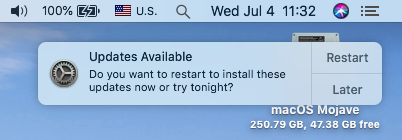
It’s also possible the update was interrupted; this is why we advise you have a strong internet connection before updating your Mac. These are core issues with a Mac which won’t update. If you’re experiencing issues, get hold of Apple for support.
Conclusion
New versions of macOS are exciting for Mac enthusiasts, but don’t rush to download them. Always make sure you’ve cleaned your Mac using CleanMyMac X, and back your machine up with Get Backup Pro. Another great app to download is Disk Drill, which can help you recover files you thought were lost.
All three apps are available for free as part of a seven day trial of Setapp, a robust suite of productivity apps for your Mac. Alongside Disk Drill, GEt Backup Pro, and CleanMyMac X, you’ll get unlimited access to the full Setapp library of nearly 200 excellent Mac apps.
When the trial ends, Setapp is only $9.99 per month to retain unlimited access to the full suite of apps. For families, Setapp’s $19.99 monthly plan allows full access to Setapp on up to four unique Macs. An incredible deal – give Setapp a try today!
Meantime, prepare for all the awesome things you can do with Setapp.
Read onSign Up